
Like
Diwali, Holi is celebrated across India and is one of the most important festivals,
when a national level holiday is maintained throughout the country.
Holi
is a Hindu spring festival & is also fondly called festival of colours. It is a two-day festival which starts on the Purnima (Full Moon night) falling of Falgun month of Hindu Calendar (February
-March in the Gregorian). The first day is known as Holika Dahan or Chhoti Holi or Agaza
and the second as Rangwali Holi,
Dhuleti, Dhulandi or Dhulivandan, Phagua.
Childhood Reference:
HOLI meant fun, a day to play with colours
visit houses especially which had girls
of the same age and enjoy colouring to full extent. Lots of food especially
Pua, Ras pua, Maal Pua , dahi bara &
mutton. It was a full day fun, in the morning with wet colours & in the
evening in new outfits with abeer & gulal. One such Holi memories is shared in my blog: Sweet Memories of Holi
 |
| Ras Pua |
Celebration:
Holi
celebrations start on the night before Holi with a Holika bonfire where people gather, do religious rituals in front
of the bonfire, and pray that their internal
evil should be destroyed as the bonfire starts.
The
next morning is celebrated as Rangwali
Holi - a free-for-all carnival of colours, where participants play, chase
and colour each other with dry powder and coloured water, with some carrying
water guns (Pichkari) and coloured
water-filled balloons for their water fight. Anyone and everyone is fair game,
friend or stranger, rich or poor, man or woman, children and elders. Traditionally,
washable natural plant-derived colours such as turmeric, neem, dhak, and kumkum were used, but water-based
commercial pigments are increasingly used. The frolic and fight with colours
occurs in the open streets, open parks, outside temples and buildings. Groups
carry drums and other musical instruments, go from place to place, sing and
dance. People visit family, friends and foes to throw coloured powders on each
other, laugh and gossip, then share Holi delicacies, food and drinks. Some
drinks are intoxicating. Festive foods are gujiya,
mathri, malpuas, Dahi bara and
other regional delicacies.
For
example, bhang, an intoxicating
ingredient made from cannabis leaves,
is mixed into drinks and sweets and consumed by many. In the evening, after
sobering up, people dress up in new outfits and visit friends and family.
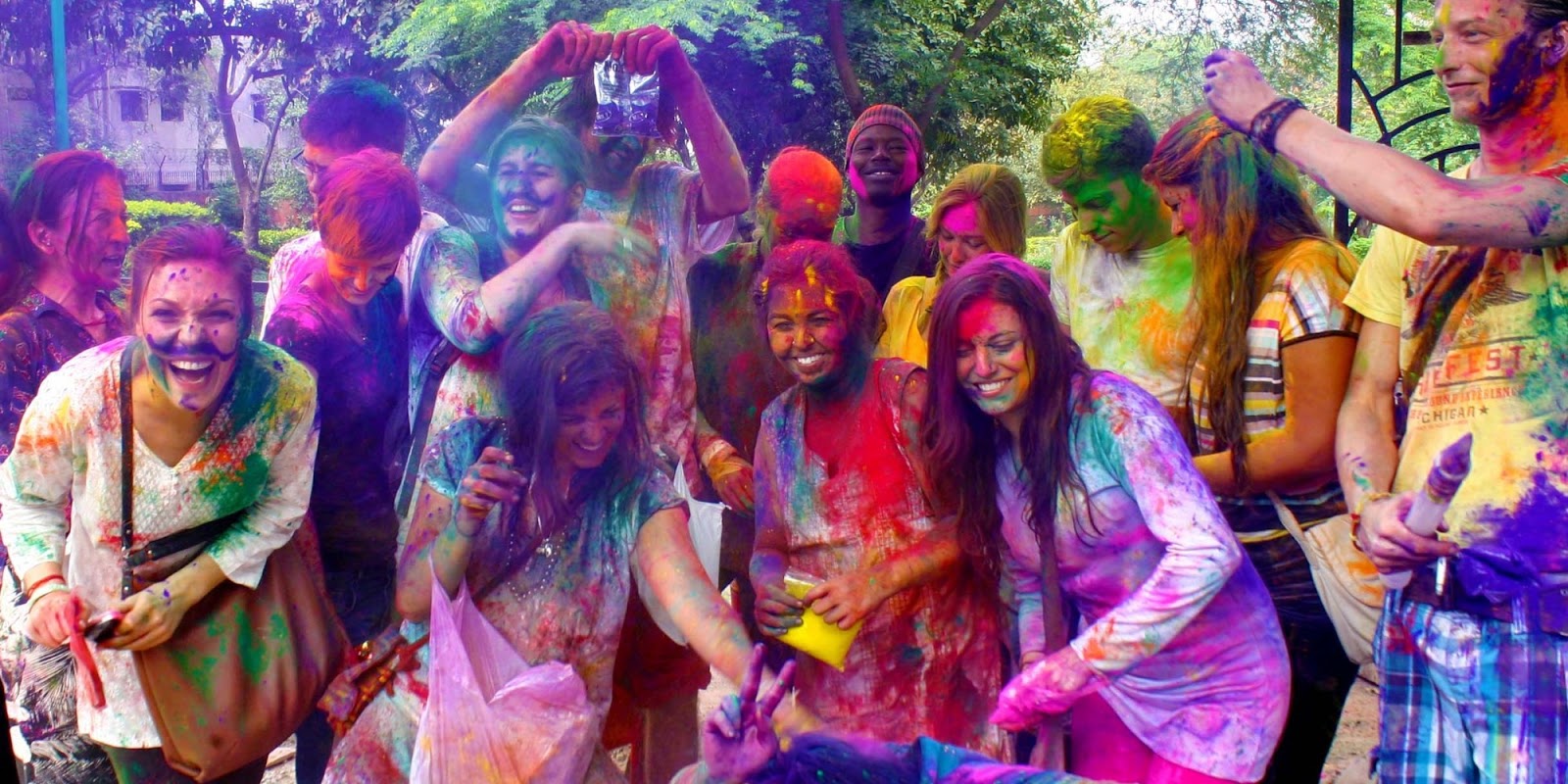 |
| Holi Celebration |
Symbolic &
Mythological Reference:
The
word "Holi" originates
from "Holika". As per
mythology Holika was the evil sister
of the demon king Hiranyakashyap. Hiranyakashyap
was the King of Multan and had earned a boon that he cannot be killed by a
human or an animal, neither on earth nor in water that virtually made him indestructible.
He grew arrogant, thought he was God, and demanded that everyone worship only
him.
Hiranyakashyap's
own son, Prahlada, however, disagreed. He remained devoted to Lord Vishnu. This
infuriated Hiranyakashyap. He subjected Prahlada to cruel punishments, none of
which affected the boy or his resolve to do what he thought was right. Finally,
Holika, Prahlada's evil aunt, tricked him into sitting on a pyre with her. Holika
was wearing a cloak that made her immune to injury from fire, while Prahlada
was not. As the fire roared, the cloak flew from Holika and encased Prahlada,
who survived while Holika burned. Seeing this, Hiranyakashyap, unable to
control his anger, smashed a pillar with his mace. There was a tumultuous
sound, and Lord Vishnu appeared as Lord
Narasimha (half man half lion) and killed Hiranyakashyap put him on his lap.
 |
| Holika Dahan |
The bonfire is a reminder
of the symbolic victory of good over evil, of Prahlada over Hiranyakashyap, and
of the fire that burned Holika and thus is called Holika Dahan. The next day, when the
fire had cooled down, people applied ash to their foreheads, a practice still
observed by some people. Eventually, coloured powder came to be used in place
of ash to celebrate Holi.
Regional Importance
In the Braj region of India, where
the Hindu deity Krishna grew up, the festival is celebrated for 16 days (until
Rangpanchmi) in commemoration of the divine love of Radha for Krishna. The
festivities officially usher in spring, with Holi celebrated as a festival of
love. There is a symbolic myth behind commemorating Krishna as well. As a baby,
Krishna developed his characteristic dark blue skin colour because the
she-demon Putana poisoned him with her breast milk. In his youth, Krishna
despaired whether the fair-skinned Radha and other girls would like him because
of his skin colour. His mother, tired of the desperation, asks him to approach
Radha and colour her face in any colour he wanted. This he does, and Radha and
Krishna became a couple. Since then, the playful colouring of Radha's face has
been commemorated as Holi.
Cultural Message
Holi
spreads the message to end and rid oneself of past errors, to end conflicts by
meeting others, a day to forget and forgive. People pay or forgive debts, as
well as deal anew with those in their lives. Holi also marks the start of
spring, and for many the start of the new year.
Some Regional Variation
In the Braj region of North India,
women have the option to playfully hit men who save themselves with shields;
for the day, men are culturally expected to accept whatever women dish out to
them. This ritual is called Lath Mar
Holi.
In Ahmedabad / Gujarat, in western
India, a pot of buttermilk is hung high over the streets and young boys try to
reach it and break it by making human pyramids. The girls try to stop them by
throwing coloured water on them to commemorate the pranks of Krishna and the
cowherd boys to steal butter and "gopis" while trying to stop the
girls. The boy who finally manages to break the pot is crowned the Holi King.
Afterwards, the men, who are now very colourful, go out in a large procession
to "alert" people of Krishna's possible appearance to steal butter
from their homes.
Outside Braj, in the Kanpur area, Holi
lasts seven days with colour. On the last day, a grand fair called Ganga Mela
or the Holi Mela is celebrated along the banks of River Ganga in Kanpur, to
celebrate the Hindus and Muslims who together resisted the British forces in
the city in 1857.
In some places there is a custom in
undivided Hindu families that the woman beats her brother-in-law with a sari
rolled up into a rope in a mock rage and tries to drench him with colours, and
in turn, the brother-in-law brings sweets (Indian desserts) to her in the
evening.
Goa Shigmo:
Holi
is a part of the Goan or Konkani spring festival known as Śigmo in Koṅkaṇī or Śiśirotsava, which
lasts for about a month. The colour festival or Holi is a part of longer, more
extensive spring festival celebrations.
Outside India, the festival is
celebrated in Nepal & entire South Asia, parts of Africa, Europe, &
America.
Aditya Sinha
09.04.2016
That’s for today with F. Tomorrow it would be another festival with “G”
List of Other Festivals : Anant Chaturdashi, Akshay Tritiya ,Buddha Purnima, Basant Panchmi, Baisakhi, Chhatha, Diwali/Deepawali, Easter, Festival of Breaking Fast - Eid ul Fitr, Ganesh Chaturthi
List of Other Festivals : Anant Chaturdashi, Akshay Tritiya ,Buddha Purnima, Basant Panchmi, Baisakhi, Chhatha, Diwali/Deepawali, Easter, Festival of Breaking Fast - Eid ul Fitr, Ganesh Chaturthi
For my parallel second Challenge blog with A pls visit : Let the Soul Pour
For other A to Z challenge blogs visit : A to Z Challenge 2016


