Showing posts with label Jwala Ji. Show all posts

Thursday, 23 April 2015

Q for Queer facts and beliefs

This post is written for A to Z Challenge.


Q for Queer facts and beliefs


Today I would talk about three temples which had left me awe struck with some stories or phenomenon linked and that keeps one pondering. I have already mentioned about one i.e. Jwalaji in my last post on Shakti Peeths. The other two are Bijli Mahadev Temple and Manikaran.


Jwalaji: The fact that it is one of the Shakti Peeth where burning tongue of Sati fell is good enough to make it sacred. 

Jwala Ji temple
But I was amazed with the continuous flame that is burning from the walls of the small rectangular pit in the main temple. There are small flames coming from other areas in the wall too. These are just small flames like a candle burning. - And goes on continuously. If scientist say it is a source of Natural Gas, I agree – but why this is only a small flame burning and not given way to a fire. Where is the source? It’s really amazing and awful.


Bijli Mahadev Temple: This temple devoted to Lord Shiva lies in Kullu district approx. 22 km from main Kullu town across the river Beas. 

Bijli Mahadev

One can reach up to Chansari village by local bus from Kullu or by road and from where one had to trek for a distance of 3 km uphill to Kashwari at a height of approx. 2500 m.
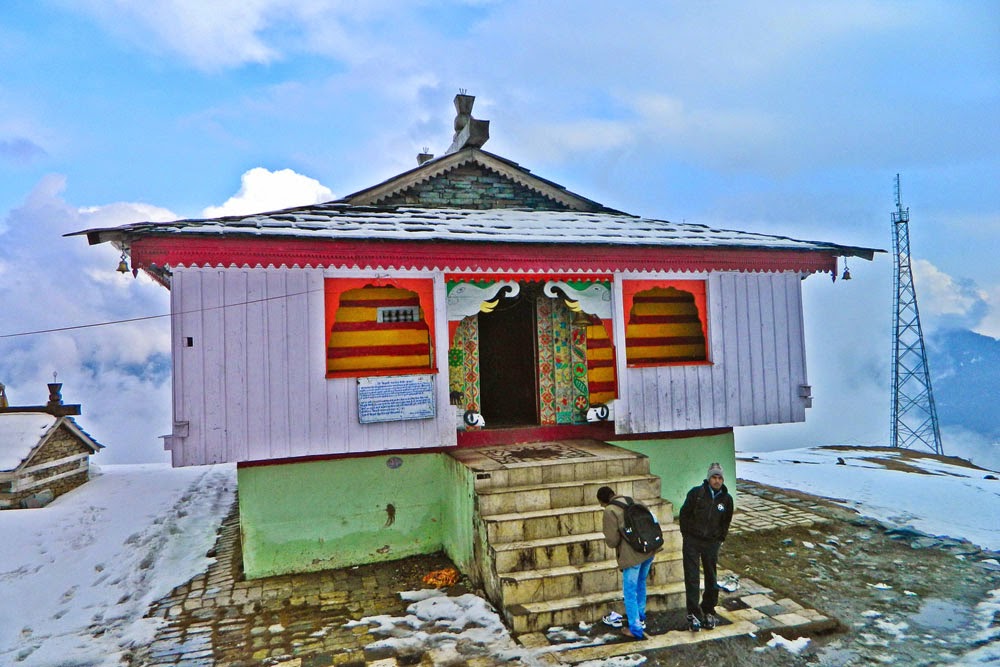

Bijli Mahadev temple

In this temple of lightning, it is said that the tall staff attracts the divine blessings in the form of lightning to save the earth. Shiva in the form of Shiva LInga absorbs the lightning and breaks into pieces and scatters. The priest then gets a dream in which he comes to know the exact location of these pieces. Then he has to restore the Shiva linga placed inside the temple using butter and sattoo. 

Shiv Linga at Bijli Mahadev

This happens after every lightning as it shatters Linga to pieces with flash of lightning.

Bijli Mahadev


The 60 feet high staff of Bijli Mahadev temple glistens like a silver needle in the sun. The top also provides a majestic valley of the parvati valley below and the Kullu city.

Manikaran: Manikaran is located in the Parvati Valley between the rivers Beas and Parvati, northeast of Bhuntar in the Kullu District of Himachal Pradesh. It is at an altitude of 1760 m and is located about 45 km from Kullu.One has to divert from Bhunter to Kasol – Manikaran route from main NH at Bhunter if you are coming from Mandi. Its just 3 kms from Kasol (the Israel city in India). The view is just mesmerizing. Manikaran is famous for the hot water Sulphur Spring. I have seen sulphur springs – many of them, But normally they are small springs or outlets with reasonably warm water. One would be astonished to see boiling hot water here virtually jutting out throughout the area. There is a Gurudwara and a Shiva temple in the same complex on the banks of river Parvati. The Rice for the food served in the Langar is prepared by just keeping the earthen pot in the kund in the Gurudwara. As a Prasad you can take raw rice / gram from the temple and leave this submerged in the kund – by the time you return after visit – the rice / gram is cooked. All along the Temple where Parvati river touches this area the water is boiling which otherwise is ice cold. Its amazing – I hadn’t seen such hot water source.

Manikaran entrance with Shiv Temple


Manikaran is a pilgrimage centre for both Hindus and Sikhs. The Hindus believe that Manu recreated human life in Manikaran after the flood, making it a sacred area. It has many temples and a gurudwara There are temples of the Hindu deities Rama, Krishna, and Vishnu. .

According to legend, when the Shiva and Parvati were walking in the valley, Parvati dropped one of her earrings. The jewel was seized by Shesha Nag which disappeared into the earth with it. Shiva performed Tandav to make Shesha nag surrender the jewel and shot the jewel up through the water. Apparently, jewels continued to be thrown up in the waters at Manikaran until the earthquake of 1905.

According to the Sikhs, during third Udasi, the founder of Sikhism Shri Guru Nanak Dev ji came to this place with his disciple Bhai Mardana. Mardana felt hungry and they had no food. Guru Nanak sent Mardana to collect food for the langar. Many people donated atta to make Roti (bread). The one problem was that there was no fire to cook the food. Guru Nanak asked Mardana to lift a stone and he complied and a hot spring appeared. As directed by Guru Nanak, Mardana put the rolled chapatis in the spring to his despair the chapatis sank. Guru Nanak then told him to pray to God saying that if his chapatis float back then he would donate one chapati in His name. When he prayed all the chapatis started floating duly baked. Guru Nanak said that anyone who donates in the name of God, his drowned items float back.

The pots containing rice for langar immersed in Hot water for being cooked

Another belief says that when the lost jewel of Parvati could not be found Shiva got angry and opened his third eye, a tremendously inauspicious event which led to disturbances in the universe. Then an appeal was made before the serpent god, Sheshnag, to pacify Lord Shiva. Sheshnag hissed thereby giving rise to a flow of boiling water. The water spread over the entire area resulting in the emergence of precious stones of the type Goddess Parvati had lost. Lord Shiva and Goddess Parvati were happy at the outcome.


The Gurudwara visible from Mandir . Also see the fumes of hot water

The name Manikaran is derived from this legend. The water is still hot and is considered extremely auspicious. A pilgrimage to this place is thought of as complete. It is also believed that there is no need to pay a visit to Kashi after visiting this place. The water of the spring is also supposed to have curative powers. 


Aside from the Main Gurudwara, and the Shiva Temple there are other temples Lord Ram Chandra and Vishnu.

This was from Q now tomorrow from R.

For other posts on Himachal written as part of Ato Z Challenge : List of post on Himachal Pradesh written as part of A to Z challenge.

Aditya Sinha

For other participants in the challenge visit : A to Z Challenge


P for Pilgrim Special - Shakti peeths in HP

This post is written for A to Z Challenge.

P for Pilgrim Special - Shakti peeths in HP


As per Hindu mythology Lord Brahma performed a yajna to please Shakti and Shiva. Goddess Shakti emerged, separating from Shiva and helped Brahma in the creation of the universe. Brahma decided to give Shakti back to Shiva. Therefore his son Daksha performed several yagnas to obtain Shakti as his daughter in the form of Sati. It was then decided that Sati was brought into this world with the motive of getting married to Shiva.
However, due to Lord Shiva's curse to Brahma that his fifth head was cut off due to his lie in front of Shiva, Daksha started hating Lord Shiva and decided not to let Lord Shiva and Sati get married. However, Sati got attracted to Shiva and finally one day Shiva and Sati got married. This marriage only increased Daksha's hatred towards Lord Shiva.
Daksha performed a yagna with a desire to take revenge on Lord Shiva near munimandala. Here Daksha invited all the deities to the yajna except Lord Shiva and Sati. The fact that she was not invited did not deter Sati from attending the yagna. She expressed her desire to attend the yagna to Shiva, who tried his best to avoid her from going but Shiva eventually relented and Sati went to the yagna. Being an uninvited guest, Sati was not given any respect at the yagna. To add to it, Daksha insulted Shiva. Sati was unable to bear her father's insults toward her husband, and she immolated herself.
Shiva on knowing this got angry and took virbhadra avatar and destroyed Daksha's yagna, cut off Daksha’s head, and later replaced it with that of a male goat as he restored him to life. Virabhadra did'nt stop fighting he kept raging with anger. Gods prayed Lord Vishnu who started fighting with Shiva. Still immersed in grief, Shiva picked up the remains of Sati's body, and started Tandava, the celestial dance of destruction, across all creation. The other Gods requested Vishnu to intervene to stop this destruction, to which Vishnu used the Sudarshana Chakra and cut the Sati's corpse. Thus, the various parts of the body fell at several spots all through the Indian subcontinent. These sites are known as Shakti Peethas today. It is believed that there are 51 Shakti Peeths across this subcontinent.

Out of 51 Shakti Peeths, Himachal is privileged to have 5 Shakti Peeths. 

1. Chintpurni Temple in Una district.

2. Chamunda Temple in Kangra district.
3. Bajreshwari Temple in Kangra district.
4. Jwalaji Temple in Kangra district.
5. Naina Devi Temple in Bilaspur district.

Chintpurni Temple in Una district : Chintpurni is around 45 km from Una towards Kangra and is motor able till the temple. It is believed that when one of the severed feet of Goddess Sati, fell in Chintpurni. It is also called Chinmastika.

Chhinmastika


Chhinmastika
Chamunda Devi : The Chamunda Devi Temple is in the heart of the city on the mainm highway from Dharamshala to Palampur about 18 kms from Dharamshala and 55 kms from Jwala Ji. It is on the banks of River Baner.

Main Chamunda Temple


The temple is dedicated to Chamunda Devi, who is a form of Durga / Shakti. Chamunda Devi Mandir is believed to be the abode of 'Shiva and Shakti'. Due to this reason, it is also known as 'Chamunda Nandikeshwar Dham'. A second belief says that the term 'Chamunda' has been derived from two words, 'Chanda' and 'Munda'. As per the mythological legends, Durga made a goddess with her power, to slay the demons, Chanda and Munda. With her immense power, the Goddess killed the demons. Goddess Durga became happy with the slaughter and blessed the goddess that she would be known and worshipped as Chamunda.

In the corner of the temple, one can see small footsteps of the Goddess on a stone. Besides the main shrine, there is a marble staircase that takes down to the cave of Lord Shiva. This is a cave-like scoop where Shiva Lingam is placed. Its a must visit.

The Hanuman Idol in the temple complex

There is also a huge Hanuman Idol on the outside of the main temple which is worth a gauge. One can spent some time on the banks of the river flowing by the sides of the temple.


River Baner

The river sight besides temple


Bajreshwari Devi : Situated in the main Kangra district is believed to have been built on charred breasts of Sati.  Worth noticing in this white temple are the three Gumbaj of the temple which are designed as a temple , a mosque and a Gurudwara. This is also called Kangra Devi or Nagarkot Dham.

Bajreshwari Devi


Jwala Ji or Jwalamukhi : is 48 km south of Dharamshala or 30 kms from Kangra. If you are coming by road from Una, you can divert from Dehra to Jwalamukhi which is around 25 kms from Dehra. Its believed that the burning tongue of Goddess Sati fell in the Jwalamukhi region. 

The  main entry of Jwala ji

In the main Temple you can see continuous flames coming out which is till date unexplained.

Jwala ji Jyoti in Jwala ji complex

Jwala Ji
Its believed that once Akbar didn't believe in the sacredness of the temple, yet offered a gold Chhatra for the temple which Goddess didn't accept and converted the metal in a mysterious metal. The chhatra is still preserved here of which no scientists have been able to detect the exact nature of the metal till date.
Chhatra givedn by Akbar

Naina Devi : The eyes of Goddess Sati fell here. Naina Devi falls in the Bilaspur region of Himachal Pradesh. One can turn uphill around 24 kms  towards Naina Devi from Anandpur Sahib in Punjab to reach here. It is believed that the eyes of Sati fell here.


Mata Naina Devi

Naina Devi Temple


If one is travelling to visit only shakti peeths from Una/ Chandigarh , he can first visit to Chintpurni, then to Bajreshwari Devi, and lastly Chamunda. On the next day one can visit Jwalaji early and then move to Naina Devi and way back to Chandigarh.


This was with P. Tomorrow it would be Q.


For other posts on Himachal written as part of Ato Z Challenge : List of post on Himachal Pradesh written as part of A to Z challenge.

Aditya Sinha

For other participants in the challenge visit : A to Z Challenge